Homeowners' pick for appliance repair across the West
Oven Repair — Book a Visit Today
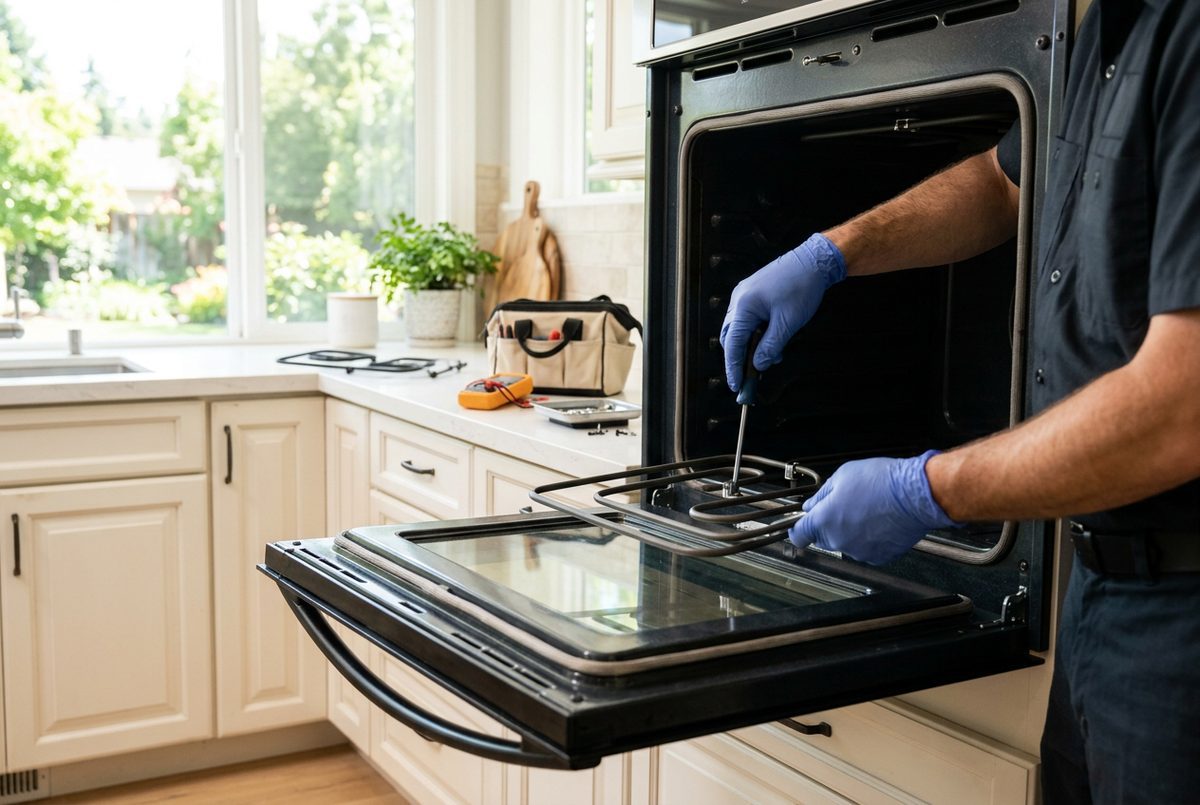
We repair ovens and ranges, gas and electric, wall ovens included, all major brands. Most ovens fail slowly. The bake element cracks, the igniter weakens, the temperature sensor drifts twenty degrees off, and dinner comes out wrong for weeks before anyone picks up the phone. Control boards quit too, often after a power flicker, and sagging door hinges let heat leak out. When we get there we run the oven through a heat cycle, read the sensor resistance, check the igniter draw, and look over wiring and connectors for burn marks. Then we tell you what we found in plain words and which parts the repair needs. We are independent, so our advice is not tied to any manufacturer. Call us and describe what your oven is doing.
Call (800) 712-6387- A real person answers
- Open 7 days
- Written quote before work starts
Taking calls until 5:00 PM MT
The oven symptoms we hear most
- "It never gets to temperature" Weak bake element, a failing igniter, or a temperature sensor reading high
- "Everything burns on the bottom" Sensor drift, lost calibration, or a shorted element cycling too long
- "The oven won't turn on at all" Blown fuse, tripped breaker leg, dead control board, or an open thermal cutoff
- "It clicks and clicks but never lights" A cracked gas igniter that no longer pulls enough current to open the valve
- "There's a code on the display" Control board fault, an open sensor circuit, or a stuck door lock motor
Safe things to check first
Worth a look before you call — sometimes it saves you the visit.
- 1Make sure the breaker for the oven has not tripped, and check both legs on a double breaker.
- 2Pull the racks out and look the bake element over for cracks, blisters, or a broken spot.
- 3During a bake cycle, feel along the door edges for heat escaping past the seal.
- 4See whether the oven is stuck in Sabbath, delay start, or self-clean lock mode.
What homeowners get from an independent shop
| Atlas Appliance Service | Big-box repair chains | Handyman listings | |
|---|---|---|---|
| You approve a written quote first | ✓ | ✕ | ✕ |
| Phones answered by people, every day | ✓ | ✕ | ✓ |
| Gas and electric, all major brands | ✓ | ✓ | ✕ |
| Independent shop, nobody's quota | ✓ | ✕ | ✓ |
| Techs who know the local housing | ✓ | ✕ | ✓ |
What homeowners say after the visit
“Fixed the ice maker and showed me why it jammed so I can stop it happening again.”
Ray S.Peoria, AZ“Washer walked across the floor on spin for a year. Turns out one shock absorber. Wish I had called sooner.”
Beth L.Eugene, OR“Showed up in the window they promised, wore boot covers, cleaned up the lint mess. Small things, but they add up.”
Omar F.Tempe Junction, AZOven Repair — quick answers
How far off can an oven be before it needs service?
Most ovens hold within about twenty-five degrees of the setting. Swing wider than that, or bake unevenly front to back, and the sensor or element is usually behind it. We measure the actual cavity temperature instead of guessing.
Is a gas oven safe to keep using if it smells?
No. Shut the gas valve off and open windows. If the smell is strong, leave the house. Call your gas utility first. Once they have cleared the line, reach us and we will look at the valve and burner assembly.
Why did my oven quit right after self-clean?
Self-clean pushes the cavity past 800 degrees. That heat commonly opens a thermal fuse or cooks a connection on the control board. It is one of the most frequent reasons an oven works fine one day and is dead the next.
Do you handle built-in wall ovens?
Yes. Wall ovens take more care because they sit in cabinetry and often have to come out of the opening before we can reach wiring and boards. We plan for that time and protect the surrounding finish while we work.
Can old ovens still get parts?
Often, yes. Elements, sensors, igniters, and thermostats stay available for years. Control boards on discontinued models are harder to find. We check availability before we recommend a repair, so you are not waiting on a part that no longer exists.
How long does a typical oven repair take?
Many are one visit, when the failed part is a common element, igniter, or sensor. Boards and specialty parts mean a return trip after ordering. We tell you which situation you are in before we leave the house.
How it works
- Step 1
Tell us the symptom
Call us or fill out the form and describe what you hear, smell, or see. A noise, a leak, an error code, the smell of something burning. Small details help us load the right parts on the van before we head out.
- Step 2
We come look
A technician comes to your home and tests the machine instead of guessing at it. You'll hear what failed, what the fix takes, and what we'd do if this were our own kitchen.
- Step 3
Repair and check
A lot of parts ride with us, so common failures get handled on the same visit. Harder parts we order in. Then we run the appliance through a cycle and make sure the problem is actually gone.
- A real person answers
- Open 7 days
- Written quote before work starts
Why homeowners call us
- Western conditions, plainlyHard well water scales up dishwasher jets and water heater lines. Summer heat leans on refrigerator compressors. Cold garages freeze washer valves in winter. We see those patterns weekly, so we check for them before chasing something exotic.
- Brand independentWe aren't tied to any manufacturer. That means we work on the mixed lineup most homes actually have: one brand of range, another brand of laundry, a fridge somebody bought used. Same technician, same visit.
- Steady, not rushedRushing is how a diagnosis goes wrong. We take the time to pull the panel, test the part, and read the board. And if a repair doesn't make sense for the age of the machine, we'll say so out loud.
- Straight schedulingYou get a real appointment window and a heads-up when the technician is on the way. Rural addresses and long mountain driveways are normal for us. Tell us about the gate or the gravel and we'll plan for it.
- All major brands, gas & electricIndependent service on Whirlpool, LG, Samsung, GE, Maytag, Bosch, KitchenAid and the rest.
- Straight answersSome machines aren't worth the part, and we say so before you spend anything.
Oven Repair
Small faults become big ones on a schedule of their own
Describe the symptoms and we'll book the visit — takes about a minute.
- A real person answers
- Open 7 days
- Written quotes
- All major brands
- Gas & electric
Rather not call? Get a free quote →